

FAQs
Technical / General
If I build exactly in accordance with a Robust Detail for Part E of the Building Regulations, can I be sure that there is no conflict with any other regulation or standard?
Every effort is made by Robust Details Limited to ensure that Robust Details are compatible with other Parts of the Building Regulations and other building standards. However, due to the number and complexity of all the potential design solutions, it is not possible to guarantee this. Your designer should consider all relevant Regulations and standards when selecting and using a Robust Detail.
What happens if Robust Details Limited perform a spot-check sound test on one of my separating walls or floors and it fails to meet the Part E standards?
We would notify the building control body and they would then take reasonable steps to ensure compliance with Part E. This could involve remedial work and pre-completion sound testing. If this was a relatively isolated failure, local action may be sufficient. However, in the unlikely event that Robust Details Limited discovered that a specific Robust Detail was consistently performing badly, we would take corrective action which could include enhancing the design or withdrawing it altogether.
Is it possible to comply with the requirements of A3 (disproportionate collapse) of Approved Document A of the Building Regulations and still register and construct in accordance with the Robust Details?
As a result of the changes to the Approved Document disproportionate collapse should be considered for all buildings whereas previously this only applied to those having 5 or more storeys.
Generally speaking we are satisfied that Robust Detail cavity masonry separating walls are compatible with the provision of effective anchorage required to meet disproportionate collapse requirements.
However, where this is achieved by the use of straps, in order not to compromise the sound resistance between dwellings, it is important that they do not bridge the cavity but that instead they are turned down into the cavity to anchor the floors.
Alternative forms of construction, such as an E-FC-2 in-situ concrete floor within a reinforced concrete frame construction or E-FS-1 steel/concrete composite floors for use in steel frames, can also achieve compliance with A3 and be registered with Robust Details Limited.
We would confirm that it is a matter for those designers, developers and builders who intend to use Robust Details to ensure that their design also satisfies all other relevant statutory or regulatory requirements. Where necessary guidance should also be sort from your suppliers with regard to any additional measures required to accommodate your proposals, for example the inclusion of straps where a resilient layer is used directly above a precast concrete plank separating floor.
I am currently already using Robust Details, does this mean I do not have to carry out PCT sound testing?
In adopting the use of Robust Details, to avoid the need for pre-completion sound testing, builders are required to register each plot with Robust Details Limited, indicating which Robust Details will be used in each case. Please refer to the Plot Registration section of this web site for more details.
Do you have a list of acoustic materials, such as floating floor treatments (FFT), which meet the requirements of the Robust Details and/or have been tested in accordance with the Appendices to the Robust Details Part E Handbook?
We do not maintain a list of materials, suppliers or manufacturers related to the acoustic materials to be used in the construction of the Robust Details. However, some of the web sites listed in the Directory may assist you in identifying suitable products.
How are PC stairs for apartment blocks and stair well landings dealt with in respect to Robust Details?
The construction of separating walls to stairwells and PC stairs and stairwell landings does not fall within the remit of Robust Details Limited. Accordingly, it is necessary to construct these elements in accordance with the Approved Document E, which indicates that sound testing of such areas would not normally be required.
We are converting/renovating an existing building, can we register the separating walls and floors with Robust Details Limited?
No, you are only able to register Robust Details for new build purpose built dwelling-houses and flats.
We are constructing a new dwelling against an existing dwelling such that the existing external wall will now form part/all of the separating wall, can we register this wall and/or separating floors that have a junction with this wall with Robust Details Limited?
No, you are only able to register Robust Details where all elements of the Robust Detail are constructed as new build as the wall/floor, including the flanking details, must be constructed as indicated in the current Robust Details Part E Handbook.
Can I use the robustdetails™ scheme for timber frame dwellings above a concrete transfer slab separating ground floor parking from the apartments above?
It is acceptable to construct timber frame dwellings above an insitu concrete transfer slab provided the junction between the timber frame separating walls are constructed following the requirements of the raft foundation detail of E-WT-1 or 2 as appropriate. It is not acceptable to construct Robust Detail timber frame separating walls off a continuous precast concrete plank separating floor.
Do I need to use Robust Details for separating walls and floors between the dwellings and the common parts of a building such as stairwells in a block of flats?
The Robust Detail separating walls and floors relate to the elements separating adjacent dwellings. The elements between the dwellings and the common parts of a building, such as stairwells, form part of the flanking elements associated with the separating elements between the dwellings. In the context of the use of the Robust Details, the walls between the dwellings and the common parts should, as a minimum, meet the requirements of the external (flanking) wall indicated in each Robust Detail.
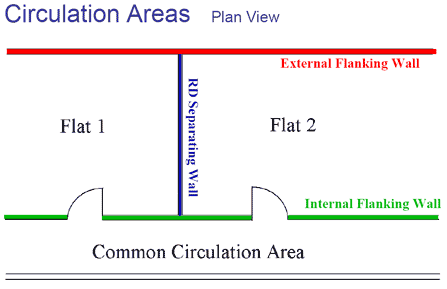
However, the elements between the dwellings and the common parts would not normally be subject to pre-completion testing in any case and should be acceptable if they are constructed in accordance with Approved Document E.
Technical Walls
Is it acceptable to close the top of a cavity masonry separating wall with blocks laid flat bridging the two leaves?
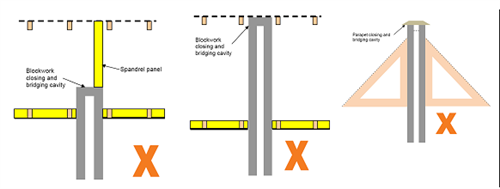
Please refer to the Robust Details Handbook for acceptable roof junction details.
Other than where indicated within a Robust Detail Specification, there should be no rigid connection between the leaves of a Robust Detail cavity masonry separating wall other than an appropriate foundation and appropriate wall ties. It is therefore NOT acceptable to use blocks laid flat to close the top of the cavity masonry wall, either where spandrel panels are proposed or at the roof covering. A flexible closer, such as mineral wool, should be used to close the cavity such that there is no rigid connection between the wall leaves.
Are Robust Details timber separating walls and floors compatible with external (flanking) walls built to Energy Savings Trust timber frame specifications?
The required acoustic performance of E-WT-1 and E-WT-2 would not be affected if the external (flanking) walls associated with the separating walls in houses was constructed as shown in the EST details.
In the case of flats, the Robust Detail handbook indicates that the finish to the external flanking wall requires two layers of gypsum-based board - this would be at variance with the EST details and further testing would be required before the effects on flanking transmission for the floor construction could be assessed.
Can insulation be placed within the cavity of the Robust Details cavity separating walls?
Several of the Robust Detail cavity separating wall specifications do permit the cavity to be insulated but, unless specifically noted in the Robust Detail specification in the Robust Details Part E Handbook, the cavity of the separating wall should not be insulated.
Can the Robust Details separating walls be constructed off steel beams?
No, the separating walls must only be connected by suitable wall ties and at the foundation, in accordance with the ground floor junction detail as shown in the relevant separating wall detail in the Robust Details Part E Handbook.
Can we construct the Robust Details cavity masonry separating walls off a continuous raft foundation?
It is not acceptable to construct the Robust Detail cavity masonry separating walls directly off a continuous floor such as a raft foundation. However, some of the Robust Detail cavity masonry separating walls may be constructed off continuous raft foundations if the Icopal-MONARFLOOR® BRIDGESTOP ® system is used. Please refer to Table 6a in the Introduction and Appendix A1 of the Robust Details Part E Handbook for details.
The layout of floors in my development of flats/apartments results in the cavity of a separating wall being bridged, is this acceptable?
No, other than E-WS-2 in concrete frame construction, the cavity separating walls must only be connected by suitable wall ties and at the foundation, in accordance with the ground floor junction detail as shown in the relevant separating wall detail in the Robust Details Part E Handbook. However, it may be possible, depending on the design, to use Robust Details for parts of the block, although specialist advice should be sought and the Building Control Body consulted.
Is the recess indicated in the raft detail of the timber separating walls required for acoustic reasons?
The round recess indicated in the concrete raft foundation shown in E-WT-1 and E-WT-2 is provided to enable moisture to be drained from the cavity of the separating wall to the outside of the building. The recess is shown for illustrative purposes and is not related to the required acoustic performance of the Robust Detail, for the purposes of Building Regulations Part E Requirement E1.
Accordingly, other Building Regulations or standards, which are outside our remit, would need to be considered in relation to this issue.
Is a cavity stop required at the junction between cavity masonry separating walls and concrete floors to meet the requirements of the Robust Details?
Tests have been undertaken with and without cavity stops at these junctions and these have found no relative difference in performance.
We can therefore confirm that cavity stops are not required at these junctions in order to comply with the Robust Detail, although particular attention should also be paid to Building Regulations Part B - Fire Safety to confirm that they can be omitted.
Please note that the cavity stop indicated at the separating wall/floor junction with the external (flanking) wall is required in all cases.
Can false chimneys be provided on top of the cavity masonry separating walls?
It is acceptable to install prefabricated plastic false chimneys, which sit over the top of the cavity masonry separating wall, provided:
-
the junction between the top of the wall and the roof covering, including the false chimney, is fully filled by a flexible closer
-
all other relevant requirements are strictly followed.
The required acoustic performance of any of the cavity masonry separating walls would also not be affected by the construction of a false masonry chimney at the apex of the separating wall, provided:
-
the construction does not involve room-in-roof situations
-
the construction of the false chimney does not include steelwork
-
the lowest point of bridging of the leaves of the separating wall, caused by the chimney construction, is at least 1m above the ceiling line
-
the chimney is no larger than 600mm x 600mm in horizontal cross-section
-
all other relevant requirements are strictly followed.
Technical Floors
How should the junctions of non-loadbearing timber stud internal partition walls with timber I-joist or solid timber joist separating floors be constructed?
There are alternatives available at both the base and head of partition walls. Either of the two base treatments can be used with either of the two head treatments:
1) Internal partition walls can be constructed either;
a) directly off the floating floor treatment (FFT) provided the design meets the FFT manufacturer's instructions, including additional battens to support the internal walls if necessary,
or
b) installed off the floor decking, provided the 5mm (min) resilient flanking strip is correctly installed to all perimeters of the floating floor treatment to isolate the floor from all the walls and skirtings
For structural reasons, loadbearing internal walls should normally be installed as per option b).
2) At the partition head, internal walls can be installed either;
a) up to the ceiling lining fixed via resilient bar noggins,
or
b) through the ceiling lining and fixed directly to the joists, provided the head plate fully seals the void between the wall linings such that there are no air paths from the ceiling void to the partition void.
For structural reasons, loadbearing internal walls should normally be installed as per option b)
Proprietary screeds are specified on some of the separating floors. What is meant by a 'Proprietary Screed'?
A proprietary screed is a self-compacting floor screed, which achieves a nominal mass per unit area of 80 kg/m2 as laid, without the requirement for manual or mechanical compacting.
Where a Robust Detail floor specifies the use of proprietary screeds in conjunction with an underscreed resilient layer, the proprietary screed should be installed on a polythene membrane to prevent ingress of the screed to the resilient layer. Membranes or other materials must not be provided beneath the screed where the Robust Detail states that the screed should be 'directly applied' to the structural core floor.
Can access panels/hatches be installed?
The installation of access panels/hatches would not necessarily mean that a separating floor would no longer comply with the requirements of the relevant Robust Detail specification. It would depend on whether or not the access panel/hatch was considered to potentially affect the acoustic integrity. It would be preferable to avoid them, if possible, or keep them to the absolute minimum. The following points would need to be considered and agreed with the Building Control Body:
-
the specification of the access panel/hatch (mass per unit area) should be at least the same or higher than the floor or ceiling finish or pipe casing which it replaces
-
the access panel/hatch should be fitted into a rebated frame and should include cover strips and/or seals to ensure that the junction between the access panel/hatch and the surrounding floor or ceiling finish or pipe casing is adequately sealed
-
the installation of the access panel/hatch should be such that it does not affect the acoustic integrity of the structure, for example by-passing the resilient composite battens or resilient ceiling bars
-
the use of an absorbent material, such as mineral wool, within the floor/ceiling/pipe casing void, particularly in the area of the access hatch to mitigate sound leakage (where the junction between the access panel/hatch and the surround is difficult to adequately seal)
-
it is preferable that they are located in cupboards, store rooms, corridors, or the like
-
in relation to proprietary systems, such as floating floor treatments (FFTs), the relevant manufacturer's instructions should be followed
-
all other relevant requirements of the Robust Details Handbook should be strictly followed.
Can underfloor heating be installed in E-FC-10?
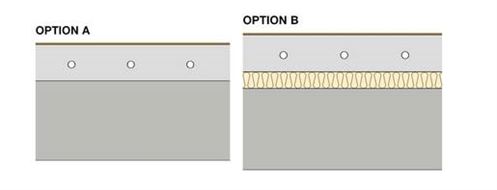
Underfloor heating may be installed in the E-FC-10 separating floor if a screed layer, in which the underfloor heating system is installed, is laid on top of the insitu concrete structural floor. The 3mm IsoRubber Top should fully cover the floor area over the top of the screed finish.
Appropriate screed depth cover to the heating system must be designed for - contact the underfloor heating manufacturer for guidance
If required, it is permissible to have an insulation layer between the screed and the insitu concrete structural floor (Option B).
Can ventilation ducts be installed within ceiling voids of separating floors?
It is acceptable to do this provided the acoustic integrity is maintained as detailed in Appendix A1 of the Robust Details Part E Handbook.
My proposed floating floor treatment (FFT) follows the description of material given in the Robust Details Part E Handbook, does it still require testing in accordance with the Appendix?
Yes, all floating floor treatments must have been benchmark tested in accordance with the appropriate Appendix to confirm that they meet the required acoustic performance.
Do you have a list of downlighters that have been tested in accordance with Appendix F of the Robust Details Part E Handbook?
We do not maintain a list of downlighters that have been tested, we recommend that you request confirmation from your supplier or the manufacturer, possibly through a copy of the acoustic report undertaken to confirm compliance with the Appendix F test.
Can downlighters be installed at a greater density than one light per 2m2?
Provided the downlighters have been tested in accordance with the requirements of Appendix F of the Handbook we can confirm that the density used in a successful test can be used.
Is it acceptable to provide a smaller void than that indicated in the ceiling treatments for the Robust Details but compensate with mineral wool insulation?
No, the full ceiling treatment including void, as indicated in the relevant section of the separating floor in the Robust Details Part E Handbook, must be followed.
Does the floating floor treatment (FFT) to the separating floor have to extend beneath kitchen units and sanitary fittings, including baths?
It is permissible to have kitchen units and appliances along with bathroom sanitary fittings installed directly onto the sub floor construction. In all cases we would always recommend that you contact the manufacturer directly to seek their advice relating to the specific FFT.
Should I register the separating floor between flats/apartments and garages in different ownership?
The floor of the flat/apartment above garages owned by third parties is a separating floor and consequently should comply with Building Regulations Approved Document E. However, the requirement for pre-completion sound testing of this element should be clarified with the relevant Building Control Body, since the details of Approved Document E (2003) are not explicit on this issue.
The floor could be constructed as a robust detail separating floor provided all the relevant requirements of the current Robust Details Part E Handbook are followed. This would include the flanking construction and the required finishes above and below the floor.
If the flat/apartment with garages is attached to other dwellings consideration would be required for the separating walls to each side, if they are to be Robust Details. This would be acceptable provided all the relevant requirements of the Robust Details Part E Handbook are followed. This would include the flanking construction and the required finishes to both sides of the separating wall.
Should I register the separating floor between flats/apartments and a driveway?
The floor of the flat/apartment above the driveway is an external element rather than a separating element and consequently is not required to comply with either Building Regulations Approved Document E or Robust Details Part E.
However, consideration would be required for any walls to each side of the driveway, which become separating walls from first floor level, if they are to be Robust Details. This would be acceptable provided:
-
The walls are constructed as cavity walls for their full height
-
there are no steel beams used at the wall/floor junction to support the floor structures, other than steel beams at right angles to the wall with only the end of the beam built in accordance with the detail on page 4 of Appendix A1 of the Robust Details Part E Handbook
-
the details of Robust Details Part E Handbook are adopted from the level of the first floor structure upwards, in particular the requirement for a clear cavity for cavity separating walls must be followed.
Should I register the separating floor between flats/apartments and a car park?
The floor between flats/apartments above a car park may be subject to pre-completion sound testing regardless of the use of Robust Details because it is an element separating different uses. This should be clarified with the relevant Building Control Body/Planning Authority.
The floor could be constructed in accordance with the principles of a Robust Detail separating floor provided all the relevant requirements of the current Robust Details Part E Handbook are followed.
This would include the flanking construction and the required finishes above and below the floor. However, this may not avoid any requirement for pre-completion sound testing as indicated above.
Consideration would need to be given to the construction used in relation to any separating walls constructed directly off this floor, for the flats/apartments immediately above the car park. Depending on the design and form of construction adopted, it may not be possible to comply with the requirements for the current Robust Details separating walls. Consequently, these walls may be subject to pre-completion sound testing. Please contact us to discuss this matter, if applicable.
The separating walls and floors of any higher storey flats/apartments on floors above the flats/apartments immediately above the car park could comply with Robust Details and avoid pre-completion sound testing. In order to achieve this, the construction of all the flats/apartments would need to follow all the relevant requirements of the current Robust Details Part E Handbook.
Is it acceptable for lifting holes in the sub-deck of cassette floors for timber or steel frame construction to be left untreated?
The required acoustic performance of any of the Robust Detail timber or steel frame separating floors would not be affected if lifting holes within the sub-deck remain untreated, provided:
-
each lifting hole is no larger than 120mm in diameter
-
mineral wool quilt, of the appropriate specification as indicated in the relevant separating floor specification, is provided covering the whole area of the floor, between the joists/battens, in both the structural floor void and the floating floor void
-
all other relevant requirements are strictly followed.
Lifting holes that are larger than 120mm in diameter should be sealed or covered with a board or panel of similar or greater density than the sub-deck board.
How should the junctions of internal partition walls with concrete separating floors be constructed?
The junction between internal partition walls and concrete separating floors should be formed as follows:
-
Install internal lightweight stud partitions either up to the ceiling lining or through the ceiling lining, provided the head channel of metal stud partitions or timber frame, as appropriate, fully seals the void between the wall linings, such that there are no air paths from the ceiling void to the partition void.
-
Install loadbearing masonry internal partition walls up to the underside of the floor, provided the floor is continuous over the wall and the wall has a minimum mass per unit area of 120kg/m2 (including the finish) OR at least that of the approved flanking wall inner leaf, if this is less.
-
Construct the internal wall directly off core floor with the floating floor treatment (FFT) or screed installed around the internal walls, provided:
-
the 5mm (min) resilient flanking strip or isolating edge strip, as appropriate for the robust detail adopted, is correctly installed to all perimeters of the FFT or screed to isolate the floor from all the walls and skirtings.
-
Construct the internal wall off the floating floor treatment flooring board or screed, provided:
-
the floating floor treatment is installed in accordance with the manufacturer’s instructions, including the provision of additional battens to support the internal walls if necessary.
-
All other relevant parts of the Robust Details Part E Handbook are strictly followed.
General
Can I buy Robust Detail plot registrations online?
Yes you can, you will have to become a member on the site first. Click here to register
Can I register existing plots which I intend to renovate using a Robust Detail?
Robust Details only applies to new build attached dwellings. Extensions to and renovations of existing dwellings cannot be registered with the RDL Scheme.
Once the dwellings are completed, who do I need to send the checklist(s) and compliance certificate(s) to?
These do not need to be returned to Robust Details Limited. You will need to retain these documents and make them available to your Building Control Body.
How can I obtain duplicate registration documents if I have misplaced the originals?
We are happy to email you replacement documents, please contact customerservice@robustdetails.com or phone 03300 882141.
I have changed the detail that I am building to. Do I need to notify you about the change?
You will need to notify RDL of any cancellations or amendments so we can update our records and issue new documents. There is an administration fee for amending the registration. You must also notify the designated Building Control Body of any change. Click here for the paper amendment / cancellation form or here for our online amendment system.
I have started construction on site and am near the completion stage, can I still register my plots with RDL?
It is preferable that you register your site before building commences. You may still register your plots providing your Building Control Body will accept the late registration. When submitting your application, you will need to provide confirmation of your Building Control Body's acceptance of late registration.
If I register plots in order to use Robust Details, can the Building Control Body still ask for sound testing of the separating walls and floors?
The Building Control Body will not ask for routine pre-completion sound testing provided the separating walls and / or floors are built strictly in accordance with the Robust Details specifications.
When do I need to start using Robust Details?
Subject to a final announcement by the Office of the Deputy Prime Minister, we anticipate that all new attached dwellings in England and Wales which are started on or after 1 July 2004 will require the use of registered Robust Details or pre-completion testing. Please confirm this with your Building Control Body.
How do I go about registering with RDL?
Firstly, access is needed to the Robust Details Part E Resistance to the passage of sound handbook. This is free as a PDF copy when you create an online account. The Handbook provides detailed information on the wall and / or floor constructions required for completing the Plot Registration Form to register your site.
How much does it cost to register my site?
Registration costs £40+VAT per dwelling. Click here to find out more about registration.
What happens after we register?
Once we have processed your Plot Registration application form we will send you a covering letter and a Purchase Statement, which a copy of must be given to your Building Control Body upon receipt. This informs them that you are building to Robust Details and they can monitor the site accordingly.
How do I go about amending site details?
You need to complete an Amendment / Cancellation Form for the plot/s you are amending or if you registered online, click here to amend your site. An administration fee will apply.
If the original paperwork is no longer available, you must write to your Building Control Body and advise them that you are amending the site details, tell them what you are amending the details to and send us a copy of that letter with your Amendment / Cancellation Form.
Where can I find out which Robust Details are compatible together?
Tables 3a, b and c in the introduction of the Robust Details Handbook provide information about compatible Robust Details.
Who is the Building Control Applicant?
The Building Control Applicant is the person whose name is on the Building Control Submission made to the Local Authority or Approved Inspector.
What is the reference number you wish RDL to quote back?
This field only needs to be completed if you have a purchase order number you wish us to quote on the receipted invoice.
What is the turn-around time for Plot Registrations?
We endeavour to process all Plot Registration applications within five working days of receipt.
What is the turn-around time to receive the printed Robust Details Handbook?
We process printed Robust Details Handbook orders on the day they arrive and you should receive your copy within 4-5 working days.
Can I place my order by telephone?
Unfortunately, we are not able to take telephone orders however, all of our forms are available to download on the website and each has the facility for you to pay by credit card.
Plot Registration Form / Plot Amendment & Cancellation Form
Do I need to send drawing in with the Plot Registration?
No, although you can if you wish to. Our technical department will review the drawings prior to us processing the application, although it may delay the turn-around of the paperwork by a few days. Please note that RDL does not offer a plan approval service, any application is assumed to be made in compliance with the current published details.
When do I need to complete the Annual Subscription Form for the printed Robust Details Handbook?
The Annual Subscription will be discontinued from 31/08/2016. Please refer to the free online handbook.
Website Sign Up
Why Should I Sign Up to the RDL Website?
You are able to view the electronic version of the Robust Details Resistance to the Passage of Sound technical handbook. This can be viewed on line or downloaded, there is also have the option to receive email news alerts from us, notification of events, handbook updates and more.
How do I create an online account on the RDL website?
Please use the Sign-in/Sign-up link on this page.
Can I amend my contact details once I have Signed Up?
Yes you are able to update any of their details once registered. We encourage you to keep your contact details up to date so that we can maintain your account accurately.
The Online Handbook
How can I view the RD handbook online?
Once you have signed up to the website can gain access to the electronic version of the handbook. Please use the Sign-in/Sign-up link on this page.
Can I download the handbook to my computer?
Yes, you can download the handbook; however you must agree to the terms and conditions of use.
What format is the electronic handbook?
The handbook is in PDF format and requires your computer to have Adobe Acrobat reader version 7.0 or later. If you do not have this installed on your machine, you can download it here for free: Download Adobe Acrobat Reader (opens new window)
Will I receive updates to the online handbook?
Yes. Our handbook is regularly updated when new details are added or where other changes are required. All those that Sign Up will receive an automatic email when the handbook has been updated. The whole online handbook will be replaced with an updated version. If you have previously downloaded the handbook, you are encouraged to replace it with the new updated version.
How long does it take to download the handbook to my computer?
The handbook file size is approximately 15Mb. The download time largely depends on your internet connection speed, but on average takes no more than 1 minute.
Will the hard copy handbook continue to be available in the future?
The hard copy handbook has been discontinued. For your free online copy please Sign Up to the website using the Sign-in/Sign-up link on this page.